


Shockwave therapy, for the pain that keeps coming back
Your heel, shoulder, hip or elbow has hurt for months. You rested it, stretched it, maybe injected it, and it came back. For four specific conditions, shockwave therapy carries some of the strongest device evidence in musculoskeletal medicine, and finding out whether yours is one of them starts with a free call.
- The first steps out of bed feel like standing on a stone bruise.
- A deep shoulder ache wakes me whenever I lie on that side.
- The outside of my hip burns on stairs, and the cortisone shot wore off.
- My elbow stings when I grip a hand, a kettle, a bag of shopping.
The conditions with the strongest evidence
- Plantar fasciitis: chronic heel pain, worst on first steps and after long days standing
- Calcific tendinopathy of the shoulder: a confirmed calcium deposit, with night and overhead pain
- Greater trochanteric pain syndrome: burning outer-hip pain on stairs, walking, and lying on that side
- Chronic tennis elbow: months of outer-elbow pain on gripping, with fading grip strength
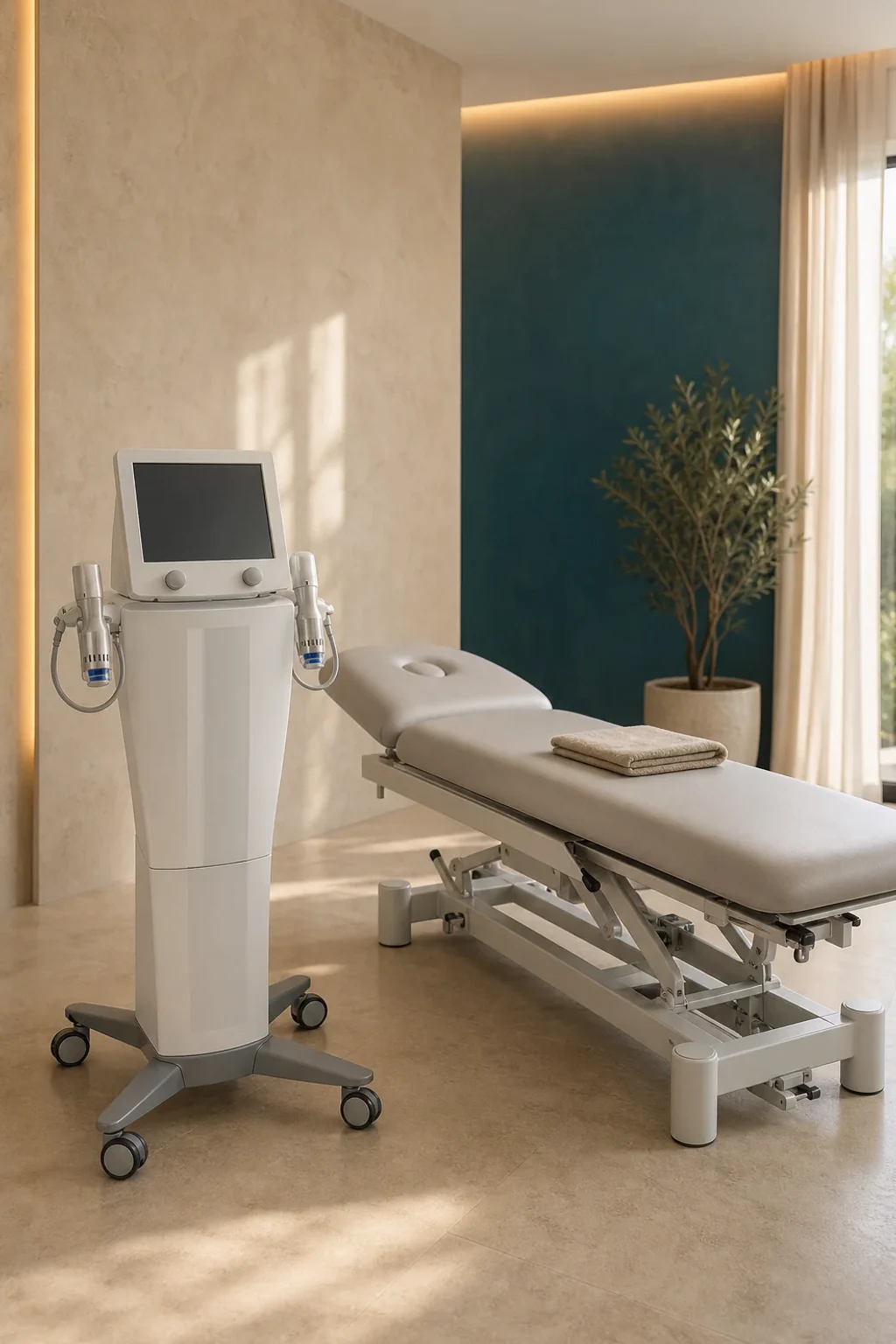
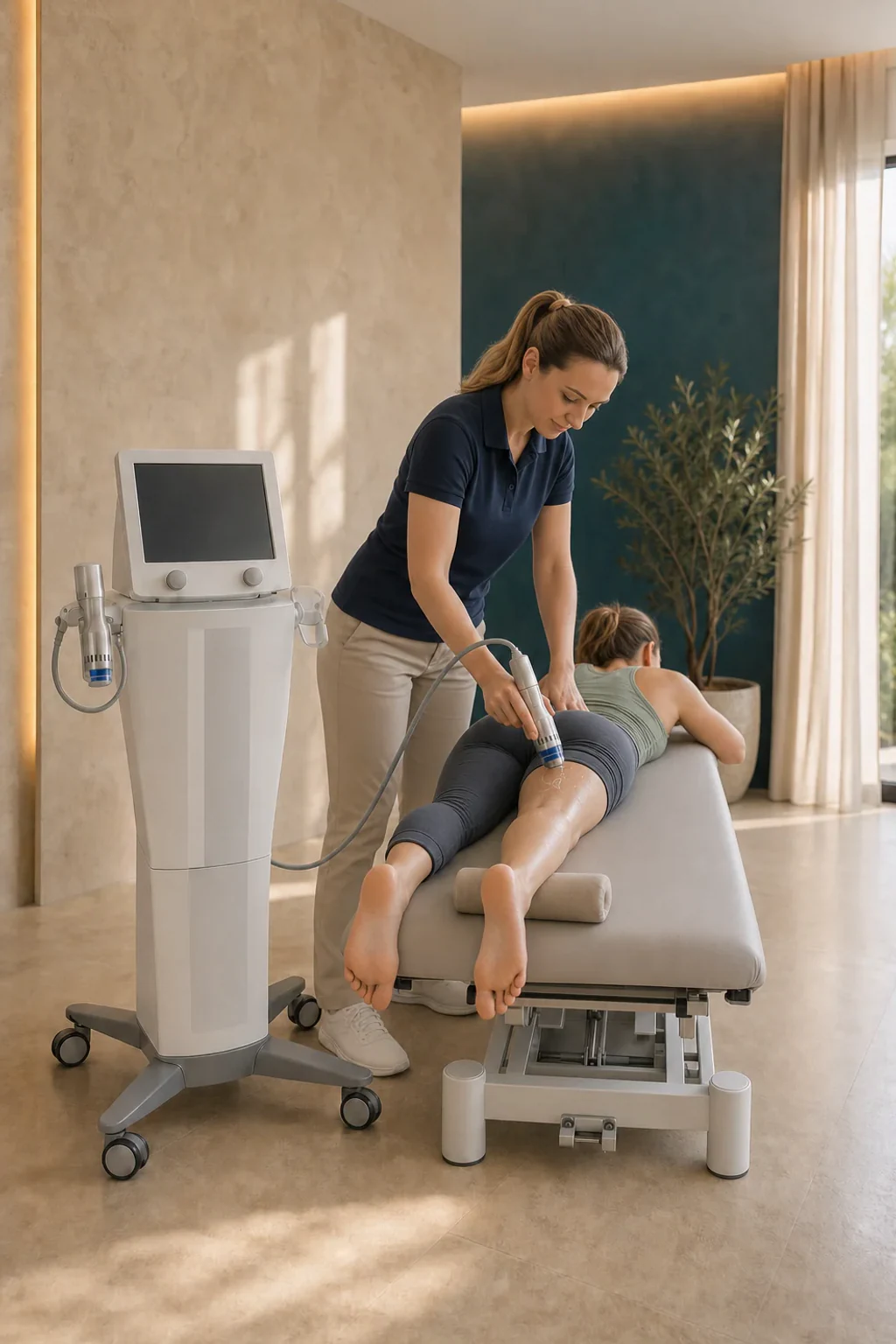
Focused acoustic pulses, handheld applicator, no incision
Within physiotherapy, never sold standalone
Progress tracked against your movement assessment
What the research shows
Shockwave is one of the best-studied device treatments in musculoskeletal medicine, and the evidence is condition-specific:
- Plantar fasciitis: a 2023 meta-analysis graded the evidence high quality, with large effects on pain and function, short and long term (Charles 2023)
- Calcific shoulder: across 28 randomized trials, high-energy shockwave consistently beat placebo, including shrinking the calcium deposit itself (Bannuru 2014)
- Outer hip pain: pooled results from 8 trials with 754 patients found less pain by 2 to 4 months and better function at 6 (Rhim 2024)
- Tennis elbow: across 13 trials with over 1,000 patients, better pain scores and grip strength than comparison treatments (Yao 2020)
- The honest caveat: for Achilles and patellar tendinopathy the same research finds negligible effects. Loading exercise comes first there, and AION will tell you so
Who may be suitable
Shockwave is chosen for a specific finding, confirmed by a physiotherapy or diagnostic assessment, not booked off a symptom alone.
It may be considered when
- Your pain matches one of the well-evidenced patterns above, confirmed by assessment
- Symptoms have lasted months despite rest, insoles or a first round of treatment
- You are able to attend a course of sessions your plan recommends
It is not offered
- As a general recovery add-on with no specific finding behind it
- Over acute fractures, infections, or certain vascular conditions
- During pregnancy, over the treatment area
What a session involves
Sessions are short and take place in the rehabilitation department. Your plan sets how many sessions make sense and reviews progress along the way.
Before
Your physiotherapist confirms the treatment area and explains what to expect, including mild discomfort during the pulses.
During
The applicator is moved over the treatment area while pulses are delivered. Most sessions take a few minutes per site.
After
Mild soreness is normal for a day or two. Your physiotherapist checks your response before the next session.
Risks and limitations
Shockwave here is delivered by trained physiotherapy staff, tied to a specific finding, never a standalone gadget session. It is generally well tolerated. Worth knowing:
- Discomfort or aching during and shortly after treatment
- Temporary redness or bruising over the treated area
- Not used over certain conditions, which your physiotherapist screens for first
Related clinical evidence
View the full clinical evidence library →The evidence behind Shockwave Therapy
Questions about Shockwave Therapy
Most people feel a dull, aching sensation during the pulses rather than sharp pain. Your physiotherapist adjusts intensity to what you can tolerate.
The strongest evidence covers four conditions: plantar fasciitis, calcific shoulder tendinopathy, greater trochanteric pain syndrome and chronic tennis elbow. For Achilles and patellar tendinopathy the trial results are honestly unimpressive, so exercise-based loading comes first there.
That is your physiotherapist's call, based on the injury and how you respond. It is reviewed as your plan progresses rather than fixed upfront.
No. AION's shockwave therapy is a musculoskeletal treatment for tendon and soft tissue injury, delivered within physiotherapy. It is unrelated to shockwave technology marketed elsewhere for other purposes.
Connected care
One body. Everything connects.
What you've just read is rarely the whole story. These are often part of the same picture.
Treatment
Rehabilitation & Physiotherapy
Sports, orthopaedic and neurological rehabilitation, built from a physiotherapy assessment, not a generic program.

Treatment
Cryotherapy
Three minutes at minus 85 degrees in an electric walk-in chamber, with screening first.
Diagnostics
Functional, Hormonal & Cognitive Health
How your body performs, how your hormones are behaving, and how your mind is holding up, measured together.
Find out if Shockwave Therapy is your answer.
One free call. You leave knowing whether AION fits your case, what it would involve, and what it costs. If the honest answer is no, you hear that too, and it costs you nothing to hear it.
Your free call is a 15-minute online conversation with the AION team. It is a first conversation, not a medical consultation.