
Recovery & Regenerative Therapies
Is Plasma Exchange Safe? What the Real Risks and Limitations Are
Plasma exchange has real, well-documented risks, and a legitimate clinic tells you about them before you ask. Here's an honest look at what can go wrong, how often, and what proper monitoring actually looks like.

TL;DR: Plasma exchange is a well-established medical procedure with decades of clinical use, but it is not risk-free. The most common issues are related to vascular access, blood pressure changes during the procedure, and reactions to replacement fluid; serious complications are uncommon but real. A legitimate clinic explains these risks clearly before treatment, monitors for them throughout, and never presents TPE as risk-free or guaranteed to work.
Why Does Asking "Is This Safe?" Matter More Than Asking "Does This Work?"
For a treatment that involves removing and replacing a large volume of a patient's plasma, safety is not a secondary question, it's the first one. A treatment can have strong evidence for effectiveness in a specific condition and still carry real procedural risk that needs honest discussion before anyone proceeds. This isn't unique to plasma exchange, it's true of any invasive medical procedure, but it's worth stating plainly here because a legitimate clinic will bring this topic up unprompted, not wait to be asked.
What Are the Most Common Risks of Plasma Exchange?
- Vascular access complications: TPE requires reliable venous access, sometimes a central line for repeated sessions, which carries a risk of infection, bleeding, or clotting at the access site
- Hypotension (low blood pressure) during the procedure, related to fluid shifts as plasma is removed and replaced
- Allergic or hypersensitivity reactions to the replacement fluid, most commonly albumin or donor plasma
- Electrolyte imbalances, particularly related to citrate (the anticoagulant used during the procedure), which can cause tingling, muscle cramps, or in rare cases more significant symptoms if not properly monitored
- Bleeding or clotting changes, since plasma exchange also removes clotting factors along with the target antibodies
Plasma Exchange Risk Categories
| Risk Category | What It Involves | How It's Managed |
|---|---|---|
| Vascular access | Infection, bleeding, clotting at the access site | Sterile technique, appropriate access choice, monitoring |
| Hemodynamic | Blood pressure drops during fluid shifts | Continuous monitoring, adjusted exchange rate |
| Allergic/hypersensitivity | Reaction to replacement fluid (albumin/donor plasma) | Pre-treatment screening, slow initial infusion rate, monitoring |
| Electrolyte/citrate-related | Tingling, cramps, rare more significant symptoms | Calcium supplementation protocols, lab monitoring |
| Coagulation changes | Temporary reduction in clotting factors | Spacing of sessions, monitoring for bleeding risk |
How Common Are Serious Complications, Actually?
Being precise matters here: serious, life-threatening complications from plasma exchange are uncommon when the procedure is performed by a trained apheresis team with appropriate monitoring, but "uncommon" is not the same as "never." Most patients experience mild, manageable symptoms like brief lightheadedness or tingling that resolve with adjustment during the session. The risk profile shifts meaningfully based on the patient's underlying condition, vascular access history, and how many sessions are planned, which is exactly why a proper pre-treatment evaluation matters rather than a one-size-fits-all approach.
What Does Proper Monitoring During Plasma Exchange Actually Look Like?
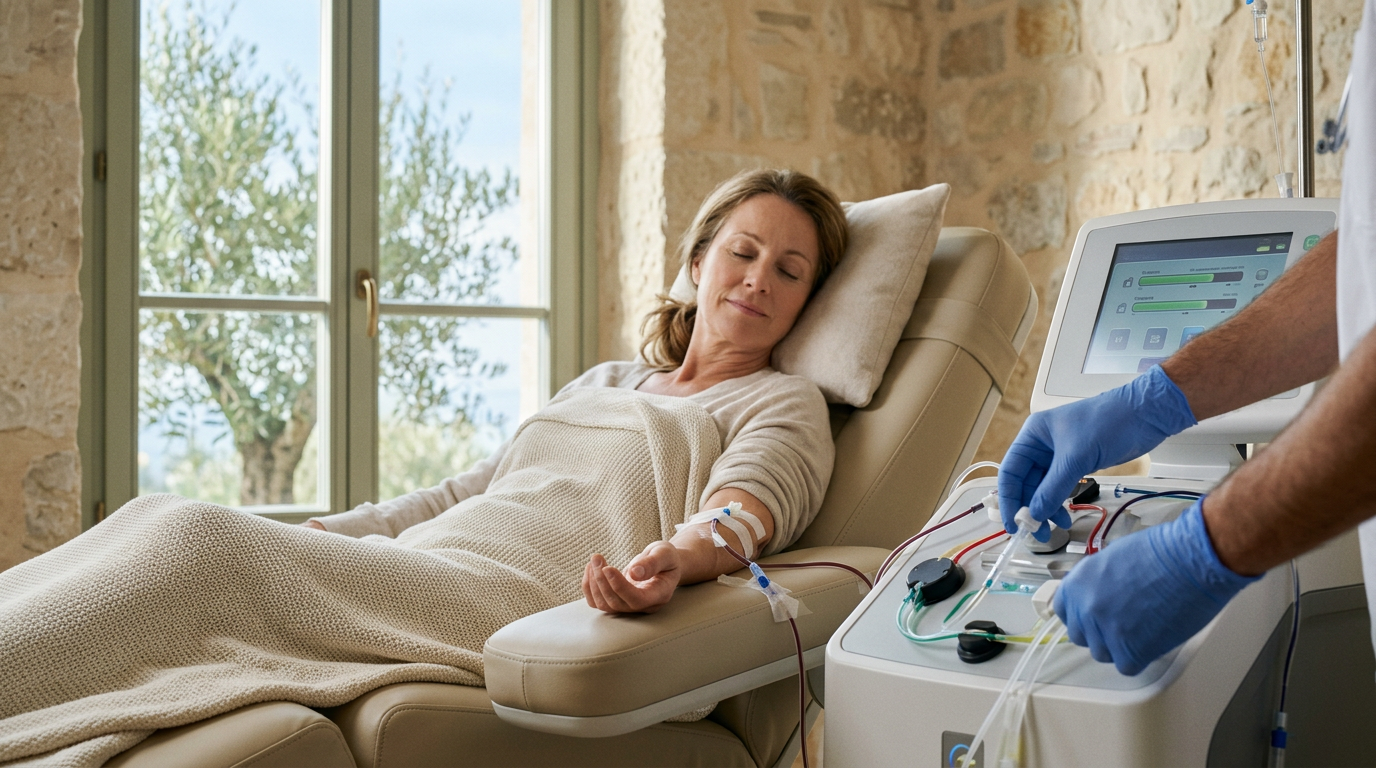
A trained apheresis team monitors blood pressure, heart rate, and patient-reported symptoms (tingling, lightheadedness, chest discomfort) continuously throughout each session. Calcium levels are managed proactively given the citrate anticoagulant used in the process, and replacement fluid is infused at a controlled rate specifically to reduce the risk of an allergic reaction. This isn't a passive infusion, it's an actively supervised procedure from start to finish.
What Should a Legitimate Clinic Tell You Before Plasma Exchange?
- A clear explanation of the specific risks relevant to your case, not a generic disclaimer
- Your actual indication and why TPE is being recommended for it specifically, referencing the evidence category if relevant
- What monitoring will look like during each session
- What symptoms during or after a session should prompt you to alert the team immediately
- Honest acknowledgment that TPE reduces circulating antibodies temporarily and does not guarantee a specific outcome
If a provider glosses over risk, avoids specifics, or frames the procedure as risk-free, that's a signal to ask more questions, not fewer.
What Makes Someone a Poor Candidate for Plasma Exchange?
Certain factors increase risk meaningfully and are part of a proper pre-treatment evaluation: active, uncontrolled bleeding disorders, severe unstable cardiovascular disease, active untreated infection, and known severe allergy to available replacement fluids. This is exactly why TPE eligibility is a specialist medical decision made after reviewing full history, not something offered universally regardless of individual risk factors.
How AION Approaches Plasma Exchange Safety
AION's plasma exchange program treats safety disclosure as part of the standard consultation, not an afterthought raised only if a patient asks. The free specialist consultation exists specifically to review your history, discuss your specific risk profile, and give an honest answer about whether TPE is appropriate for your situation before anything is scheduled.
Related AION Resources
For the broader evidence picture across all plasma exchange indications, see therapeutic plasma exchange: what it's proven to treat and where it's experimental. For condition-specific detail, see our guides on CIDP treatment options and Guillain-Barré syndrome treatment.
FAQ
Is plasma exchange a safe procedure? It's a well-established medical procedure with decades of clinical use, but it carries real risks, most commonly related to vascular access, blood pressure changes, and reactions to replacement fluid. Serious complications are uncommon but not zero.
What are the most common side effects of plasma exchange? Mild lightheadedness, tingling related to calcium/citrate shifts, and temporary blood pressure changes during the procedure are the most commonly reported, usually manageable with adjustment during the session.
Who should not have plasma exchange? People with active uncontrolled bleeding disorders, severe unstable cardiovascular disease, active untreated infection, or known severe allergy to available replacement fluids are generally poor candidates, decided through specialist evaluation.
How is safety monitored during a plasma exchange session? A trained apheresis team continuously monitors blood pressure, heart rate, and patient-reported symptoms, manages calcium levels proactively, and controls the infusion rate of replacement fluid.
Does plasma exchange affect blood clotting? Yes, temporarily. The procedure removes clotting factors along with target antibodies, which is factored into session spacing and monitored for bleeding risk.
What questions should I ask before agreeing to plasma exchange? Ask about your specific risk profile, why TPE is recommended for your case, what monitoring involves, and what symptoms should prompt immediate concern during or after treatment.
This article is for educational purposes and does not replace individualized medical advice. Always discuss your personal risk factors for plasma exchange with the treating specialist team.
Keep reading

Recovery & Regenerative Therapies
CIDP Treatment Options: Where Plasma Exchange Actually Fits In
Recovery & Regenerative Therapies
Guillain-Barré Syndrome Treatment: Why Timing on Plasma Exchange Matters

Recovery & Regenerative Therapies
Myasthenia Gravis Exacerbation: How Plasma Exchange Fits Into Treatment
This article is educational and is not medical advice. Whether any therapy is appropriate for you is a clinical decision made by a physician after an individual assessment.